McCluskieganj: Colonial Bungalows, Cinema Dreams & Sacred Unity
A journey into Jharkhand's most hauntingly beautiful hidden gem — the town that was once called "Little England," inspired a National Award-winning film, and holds India's most profound message of religious harmony.
The Town That England Forgot, But India Embraced
Picture this: It is 1933. The British Raj is at its zenith, yet a quiet anxiety stirs within the Anglo-Indian community across India. The Simon Commission has just delivered its report, and to the devastation of thousands of mixed-heritage families, they find themselves erased from the narrative of India's future. Betrayed by the empire they served and uncertain of their place in an independent India, they yearn for a homeland they can call their own.
Enter Ernest Timothy McCluskie — a visionary Anglo-Indian businessman from Kolkata with a dream as vast as the Chotanagpur plateau itself. On a fateful visit to the hilly forests northwest of Ranchi, McCluskie fell irretrievably in love with a patch of land where the air carried a crispness found nowhere else in the plains, where mist curled around sal trees like whispered secrets, and where the Damodar River traced silver threads through ancient valleys. He purchased approximately 10,000 acres from the Raja of Ratu and established the Colonization Society of India — a joint-stock cooperative where Anglo-Indians could buy shares and receive plots of land in what would become their very own "Mooluk."
Within a decade, nearly 400 Anglo-Indian families had answered his call. They built grand bungalows with high ceilings, ornate fireplaces, and wrap-around verandas. They planted guava and mango orchards, held garden parties where gramophones played jazz into the starlit nights, and created a little slice of England in the heart of Jharkhand. The town became known as "Little England" or "Mini London" — a place where Western culture, lifestyle, and language flourished amidst the wild beauty of the Indian countryside.
But time, as it always does, had other plans. After World War II, the great exodus began. Families migrated to Australia, England, and Canada. The grand bungalows were left to the mercy of monsoons and memory. Of the nearly 300 original settlers, only about 20 Anglo-Indian families remain today, guardians of a fading legacy. Yet what remains is not decay — it is poetry written in brick, wood, and wildflowers. Today, McCluskieganj stands not as a ghost town, but as a living museum — a place where every cracked fireplace and every overgrown garden path tells a story of hope, heartbreak, and the enduring human spirit.
Walking Through the Pages of History: The Heritage Bungalows
As you enter McCluskieganj, the first thing that strikes you is the silence — not the empty silence of abandonment, but the weighted silence of stories waiting to be told. Scattered across the town are over 300 heritage bungalows, each one a testament to an era when this was the summer capital of Bihar (before Jharkhand was carved out in 2000).
 Historic colonial cottage architectural details in McCluskieganj.
Some stand proud, restored by new owners who have converted them into charming homestays and guesthouses. Others lean into the earth, their roofs sagging, their windows like hollow eyes watching the passage of time. Walk through their gardens, and you will find fireplaces that once warmed families on frosty winter nights (yes, McCluskieganj witnesses frost and has recorded temperatures as low as 1.5°C in January!). The stench of bat droppings might pull you back to reality, but close your eyes for a moment, and you can almost hear the clink of teacups, the laughter of children playing croquet, and the strains of a piano drifting from a distant drawing-room. These bungalows are not ruins — they are time capsules. And in one of them, a piece of Bengali literary history was written.
The Manjulika Connection: Buddhadeb Guha's Love Affair
If McCluskieganj is on the tourist map today, much of the credit goes to the legendary Bengali author Buddhadeb Guha. The man who gave us timeless literary classics found his muse in the misty hills of this Anglo-Indian town. Guha owned a beautiful bungalow here named "Manjulika" — after his mother — and it was within these walls that he penned some of his most beloved works.
His novel "Ektu Ushnotar Jonno" (For a Little Warmth) is a love story deeply rooted in the landscapes of McCluskieganj. Through his evocative prose, Guha introduced generations of Bengali readers to the town's melancholic charm — its abandoned mansions, its whispering forests, and the poignant beauty of a community caught between two worlds. He didn't just write about McCluskieganj; he immortalized it.
The bungalow itself has passed through the hands of notable personalities — from the original owner Allen Menedis to the Gabrail family, then to Buddhadeb Guha, later to acclaimed filmmaker Aparna Sen, and eventually to the family of former Union Minister Subodh Kant Sahay. Each owner added a layer to its legend. For book lovers and literary pilgrims, visiting Manjulika is not just sightseeing — it is a pilgrimage to the altar of storytelling. Stand on that veranda, and you can almost see Guha sitting with his manuscript, watching the monsoon clouds roll over the Chotanagpur hills, weaving words that would break a million hearts.
When McCluskieganj Became a Movie Star: A Death in the Gunj
In 2016, McCluskieganj stepped out of the pages of literature and onto the silver screen in a manner so haunting, so beautiful, that it left an indelible mark on Indian cinema. Konkona Sen Sharma, in her directorial debut, chose this very town as the setting for her masterpiece — A Death in the Gunj.
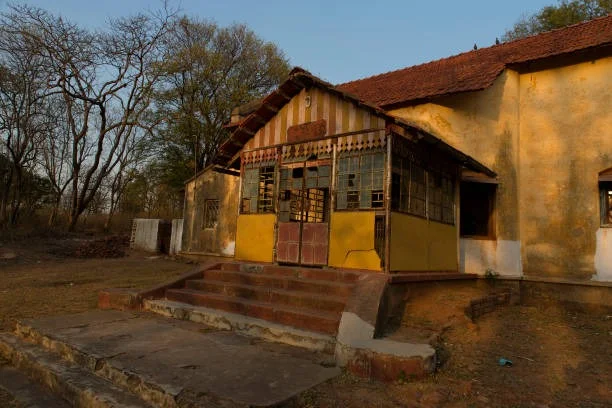 A Death in the Gunj was filmed extensively in heritage homes across the town.
Shot over six weeks in the actual bungalows and landscapes of McCluskieganj, the film is set in the winter of 1978-79 and tells the story of a sensitive young man named Shutu (played with heartbreaking brilliance by Vikrant Massey), who unravels amidst the casual cruelty of a family vacation. The ensemble cast reads like a who's who of Indian acting royalty — Om Puri, Tanuja, Tillotama Shome, Gulshan Devaiah, Kalki Koechlin, Jim Sarbh, and Ranvir Shorey. But here is what makes the film's connection to McCluskieganj truly chilling: it is based on a true story.
The screenplay is adapted from a short story by Mukul Sharma — journalist, writer, and Konkona's father. Sharma and his then-wife Aparna Sen had bought a house in McCluskieganj, and during one fateful gathering, they participated in a planchette session that went horribly wrong. When the group asked who would die first, the session pointed to their friend Chris Tripthorpe. Terrified, Chris fled — and days later, he was found dead, run over by a train. Many believed it was suicide. Sharma transformed this traumatic memory into fiction, and Konkona transformed that fiction into cinematic poetry.
When you visit McCluskieganj today, you can stand in the very bungalows where the film was shot. You can walk the corridors where Shutu walked, sit on the verandas where the family gathered, and feel the same oppressive, beautiful melancholy that the film captured so perfectly. The town does not just appear in A Death in the Gunj — it is a character in it, as vital and as tragic as Shutu himself. For cinephiles, this is no ordinary location. It is a shrine to one of the finest Indian films of the decade, a place where art imitated life in the most profound and disturbing ways.
Nakta Pahar: The Adventure Awaits
But McCluskieganj is not all melancholy and memory — it is also a playground for the adventurous soul. Just a short distance from the town lies Nakta Pahar (Nakta Hill), a distinctive hill that rises from the landscape like a sentinel guarding the town's secrets.
Nakta Hill is fast becoming one of Jharkhand's most thrilling yet undiscovered trekking destinations. The hike to the summit takes you through dense sal forests, across bubbling streams, and past rock formations that seem sculpted by ancient giants. As you ascend, the air grows thinner and cooler, carrying the scent of wildflowers and wet earth. And then you reach the top — and the world falls away. From the summit of Nakta Pahar, you are rewarded with a breathtaking 360-degree panoramic view of the entire region. The Chotanagpur plateau stretches out in waves of green and gold, the Damodar River snakes through the valleys like a silver ribbon, and on clear days, you can see all the way to the distant horizons that McCluskie himself must have gazed upon nearly a century ago. This is not a trek for the faint-hearted — the trails can be steep, and the forest thick — but for those who make the climb, Nakta Pahar offers something rare in today's world: unspoiled wilderness and absolute solitude.
Sarva Dharm Sthal: Where India's Soul Lives
If there is one place in McCluskieganj that will move you to tears and fill you with hope simultaneously, it is the Sarva Dharm Sthal — the "Place of All Religions." Located in the village of Dulmi, about five kilometers from the main town, this unassuming complex holds what might be the most profound symbol of India's secular soul.
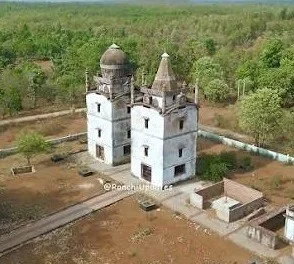
 The unique twin towers of Sarva Dharm Sthal in Dulmi village.
Here, in a single compound, stand the places of worship of four major religions: a Radha-Krishna Temple, a Mosque (housing the tomb of Noor Hasan Baba), a half-built Gurudwara, and a wooden cross marking the spot where a church was planned. There are no walls between them, no disputes over land, no cries of "mine" and "yours." There is only shared space, shared reverence, and shared humanity.
The story of this sacred unity is as fascinating as the place itself. During the British era, a saint named Noor Hasan Baba came from Delhi to Kolkata, and was eventually called to Dulmi by the British administrators. He was a man of profound spiritual power, fond of singing qawwalis that moved even his colonial patrons. When he passed away in Kolkata, his sons brought his mortal remains back to Dulmi, and the British built a beautiful mausoleum over his grave. As per his wishes, a temple and Gurudwara were also constructed nearby. A plot was marked for a church, but India's independence interrupted the plans, leaving only a wooden cross to mark the intention.
Every year on November 22, the Urs of Noor Hasan Baba is celebrated here, drawing devotees from across Jharkhand, Bihar, and West Bengal. His descendants travel from Kolkata to offer prayers at his tomb, and believers from all faiths come to place chadars, light candles, and seek blessings. Janmashtami is celebrated with grandeur at the temple, and during Christmas, the Christian community gathers at the cross to offer flowers and light candles. Right next to the Sarva Dharm Sthal lies Sita Kund — a natural spring surrounded by lotus-filled ponds. Local legend holds that during their exile, Lord Ram, Sita, and Lakshman stopped here, and Sita bathed in these waters. The spring flows constantly, its fresh water a testament to the earth's generosity.
Rivers, Waterfalls, and the Wild Heart of Jharkhand
Beyond its history, cinema, and spirituality, McCluskieganj is blessed with raw natural beauty. The Duga Dugi River (a tributary of the Damodar) flows through the town, its clear waters perfect for quiet contemplation or a refreshing dip. The Damodar River itself — once known as the "Sorrow of Bengal" for its devastating floods — now flows gentler due to check dams, but standing on the bridge and looking down at its mighty breadth, you can still feel the power that shaped this land. Nearby, the Jhunjhunia Waterfall cascades down rocky cliffs, creating natural pools where you can sit for hours listening to nothing but the music of falling water. The Kuwaarpatraa River Canyon offers dramatic views that rival any geological wonder, and the Nindra Bridge provides the perfect vantage point for photographers chasing that golden-hour shot.
St. John's Church and the Living Legacy
No visit to McCluskieganj is complete without stopping at St. John's Church — one of the oldest surviving structures built by the Anglo-Indian community during British rule. With its Gothic arches and weathered stone, the church stands as a reminder of the faith that sustained a community through uncertain times. Even if you are not religious, the silence inside its walls is meditative, the stained glass filtering the afternoon light into colors that seem almost divine.
The town is also home to the renowned Don Bosco Academy, established in 1997, which has become one of the region's premier educational institutions and brought new life (and new livelihoods) to the town through its hostels and schools.
How to Reach, Where to Stay, and When to Go
Getting There: McCluskieganj is located approximately 60-65 kilometers northwest of Ranchi and is well-connected by road via National Highway 39. The town has its own McCluskieganj Railway Station, making it accessible by train as well.
Best Time to Visit: The ideal time to explore McCluskieganj is from October to March, when the weather is cool and pleasant. Winters can be surprisingly cold (remember that 1.5°C record!), so pack warm clothes if you are visiting in December or January. The monsoon (July-September) transforms the landscape into a lush green paradise, but trekking might be challenging due to slippery trails.
Where to Stay: Several of the old bungalows have been converted into guesthouses and homestays, offering an authentic experience of colonial-era living. For budget travelers, there are smaller lodges and hostels in the town. Do not expect luxury resorts — McCluskieganj is for travelers who value experience over extravagance.
Why McCluskieganj Deserves a Place on Your Bucket List
In an age of Instagram-famous destinations and overcrowded hill stations, McCluskieganj offers something increasingly rare: authenticity. This is not a place that performs for tourists. It does not have manicured gardens or curated selfie points. It has something far more valuable — layers of history that you can touch, stories that you can feel, and a silence that speaks volumes.
Walk through the abandoned bungalows, and you will understand the fragility of human ambition. Stand in the Sarva Dharm Sthal, and you will feel the strength of human unity. Climb Nakta Pahar, and you will remember what it feels like to be alive in the wild. Watch A Death in the Gunj before you go, and when you stand in the same rooms where Shutu stood, you will carry a piece of that story in your heart forever.
McCluskieganj is not just a destination. It is a conversation — between past and present, between colonizer and colonized, between faith and faith, between art and life. It is a town that asks you to slow down, to listen, to feel.